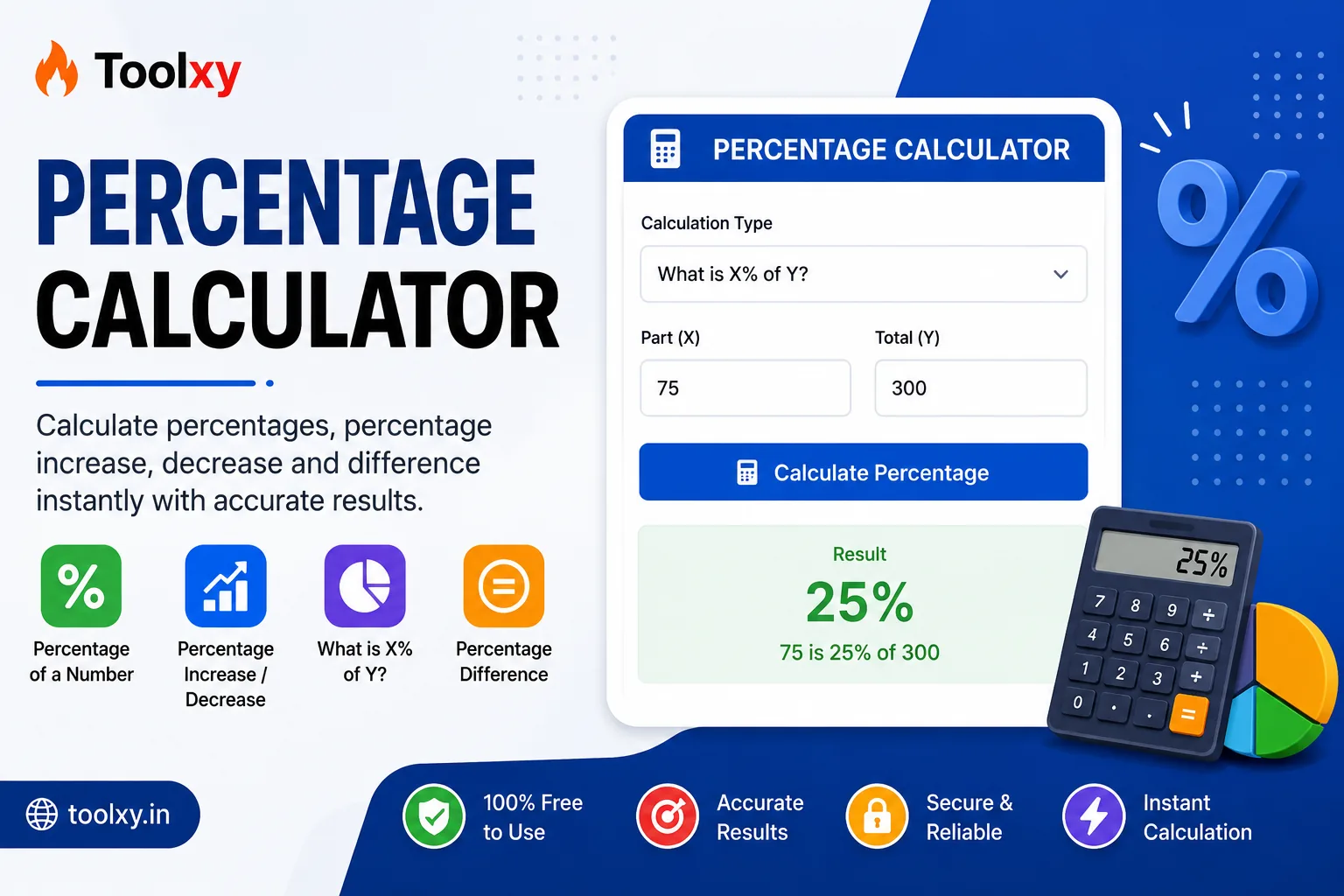
Percentage Calculator
The Percentage Calculator is a free online tool that makes percentage calculations quick and easy. You can use it to find a percentage of a number, determine what percentage one number is of another, calculate percentage increase or decrease, and find the percentage difference between two values.
Instead of performing percentage calculations manually, enter your numbers into the Percentage Calculator and get the result instantly. The tool is designed for students, shoppers, professionals and anyone who needs quick percentage calculations in everyday situations.
What Is a Percentage?
A percentage represents a value as a part of 100. The word percent means "per hundred." For example, 25% can be represented as 25 out of 100, or 25/100. Percentage is commonly used to compare quantities, calculate discounts, measure changes and understand proportions. 0
How to Use the Percentage Calculator
- Select the type of percentage calculation.
- Enter the required values.
- Click Calculate Percentage.
- Check the result displayed in the result box.
The Toolxy Percentage Calculator supports four common calculations, so you can choose the method that matches your question.
Types of Percentage Calculations
1. What Is X% of Y?
This calculation finds a percentage of a given number. For example, if you want to find 20% of 500, enter 20 as the percentage and 500 as the number. The result is 100.
The basic calculation is:
Percentage of a Number = (Percentage ÷ 100) × Number
2. X Is What Percentage of Y?
This calculation determines what percentage one number represents of another. For example, if a student scores 75 marks out of 100, the percentage is 75%.
The formula is:
Percentage = (Part ÷ Total) × 100
3. Percentage Increase or Decrease
Percentage change tells you how much a value has increased or decreased relative to its original value. It is useful for comparing prices, scores, measurements and other changing values.
The basic percentage change formula is:
Percentage Change = ((New Value − Original Value) ÷ Original Value) × 100
A positive result indicates an increase, while a negative result indicates a decrease.
4. Percentage Difference
Percentage difference is useful when comparing two values without treating either one as the fixed original value.
The formula is:
Percentage Difference = (|Value 1 − Value 2| ÷ ((|Value 1| + |Value 2|) ÷ 2)) × 100
Percentage Calculator Example
Suppose you want to calculate 15% of ₹2,000. Enter 15 in the percentage field and 2,000 in the number field. The calculator returns ₹300.
This means 15% of ₹2,000 is ₹300. The same type of calculation can be used for marks, prices, quantities, measurements and many other everyday examples.
How to Calculate Percentage Manually
You can calculate a percentage manually by converting the percentage into a fraction out of 100 and multiplying it by the number.
For example, 30% can be written as 30/100. Therefore, 30% of 600 is:
30 ÷ 100 × 600 = 180
The Percentage Calculator performs this calculation automatically, making it useful when you need to calculate several values quickly.
Percentage Increase Example
Suppose a price increases from ₹500 to ₹600. The increase is ₹100. Compared with the original ₹500, the percentage increase is 20%.
Percentage increase is useful when comparing an original value with a newer value after growth.
Percentage Decrease Example
Suppose a product price decreases from ₹1,000 to ₹800. The decrease is ₹200. Compared with the original ₹1,000, the percentage decrease is 20%.
This type of calculation is commonly used when checking price reductions, discounts and other decreases.
Percentage Calculator for Discounts
The Percentage Calculator can help you understand the percentage portion of a discount. For example, if an item costs ₹2,000 and the discount is 15%, the discount amount is ₹300.
For calculating the final price after a discount, you can also use the Toolxy Discount Calculator .
Percentage Calculator for Exam Marks
Students can use a Percentage Calculator to calculate marks as a percentage of total marks. For example, if someone scores 420 marks out of 500, the percentage can be calculated by dividing 420 by 500 and multiplying the result by 100.
This is useful for quickly checking examination results and comparing scores against a total.
Percentage Calculator for Everyday Use
Percentages are used in many everyday situations. You may encounter them while checking discounts, comparing prices, calculating marks, reviewing changes in values or understanding proportions.
The Percentage Calculator provides a convenient way to handle these calculations without repeatedly writing formulas.
Why Use the Percentage Calculator?
- Fast percentage calculations.
- Simple and easy-to-use interface.
- Supports percentage of a number.
- Calculates what percentage one value is of another.
- Calculates percentage increase and decrease.
- Calculates percentage difference.
- Works on mobile, tablet and desktop devices.
- Useful for school, work and everyday calculations.
Percentage vs Percentage Difference
Percentage change normally uses an original value as the reference point. Percentage difference instead compares two values using their average as the reference denominator.
Choosing the correct calculation is important because the two methods answer different questions.
Common Percentage Values
Some percentages are particularly easy to recognize. For example, 50% is one half, 25% is one quarter and 10% is one tenth. Understanding common percentage relationships can make mental calculations easier. 1
Important Things to Remember
- Percentage means a value expressed relative to 100.
- Percentage of a number and percentage change are different calculations.
- Percentage difference uses a different reference than percentage change.
- Always identify the original or reference value when calculating percentage change.
- Check your inputs before relying on a calculated result.
Frequently Asked Questions
What is a Percentage Calculator?
A Percentage Calculator is an online tool used to calculate percentages, percentage increase, percentage decrease and percentage difference quickly.
How do I calculate a percentage of a number?
Divide the percentage by 100 and multiply it by the number. For example, 20% of 500 is 100.
How do I calculate what percentage one number is of another?
Divide the part by the total and multiply the result by 100.
How do I calculate percentage increase?
Subtract the original value from the new value, divide the difference by the original value and multiply by 100.
How do I calculate percentage decrease?
Subtract the new value from the original value, divide the difference by the original value and multiply by 100.
What is percentage difference?
Percentage difference compares two values using the average of their absolute values as the reference.
Can I use the Percentage Calculator for exam marks?
Yes. Enter the marks obtained as the part and total marks as the total to calculate the percentage.
Can I use the Percentage Calculator for discounts?
Yes. It can calculate the percentage amount of a discount. Use the Toolxy Discount Calculator when you also need the final discounted price.
Is the Percentage Calculator free?
Yes. The Toolxy Percentage Calculator is available online for free.
Can I use the Percentage Calculator on mobile?
Yes. The calculator is responsive and works on smartphones, tablets and desktop devices.
What does 25% mean?
25% means 25 out of 100, which is equal to one quarter.
What is the difference between percentage change and percentage difference?
Percentage change uses an original value as the reference, while percentage difference uses the average of the two compared values.
Final Thoughts
The Percentage Calculator makes common percentage problems faster and easier to solve. Whether you need to find a percentage of a number, calculate percentage change or compare two values, the Toolxy calculator can provide an instant result.
For additional calculations, you can also explore the Discount Calculator, GST Calculator and EMI Calculator.
For additional learning about percentages, fractions and percentage relationships, see Khan Academy's percentage lessons .