Total Solar Eclipse 2026: Date, Time, Path, Visibility & Complete Guide
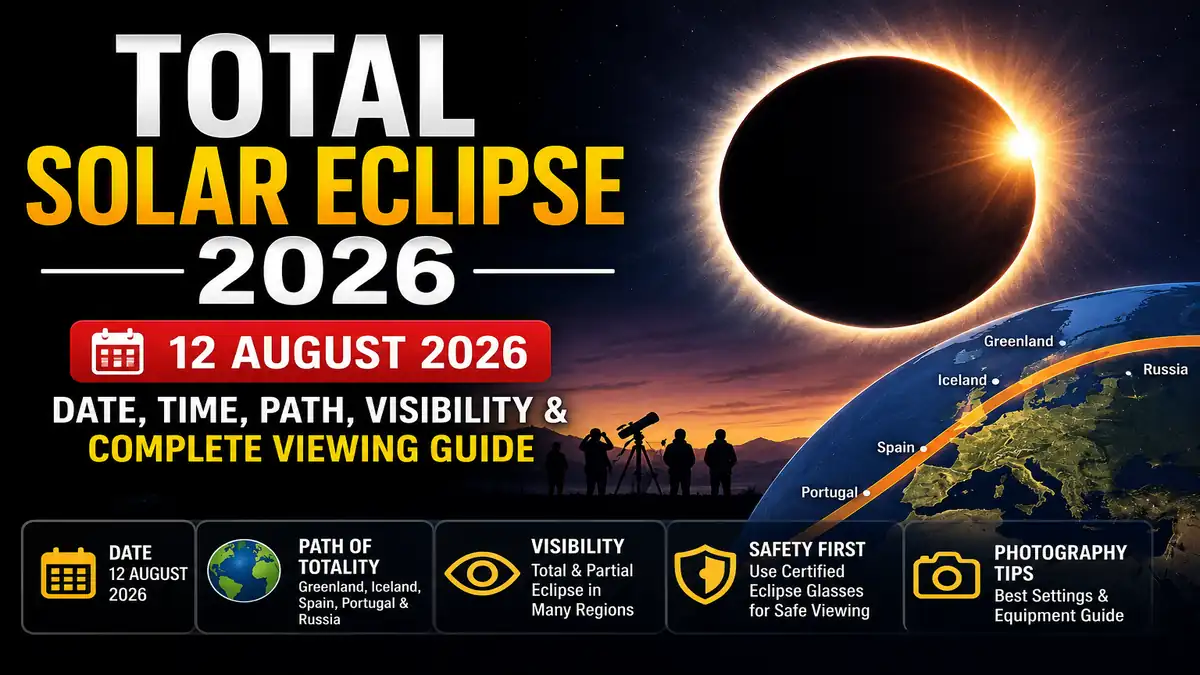
Total Solar Eclipse 2026 will occur on 12 August 2026 and is one of the most anticipated astronomical events of the decade. The Moon will completely cover the Sun along a narrow path crossing Greenland, Iceland, northern Spain, northern Russia, the Atlantic Ocean, and a small part of Portugal. Millions of people across Europe and other regions will witness either a total or partial solar eclipse. 0
This complete guide explains the Total Solar Eclipse 2026 date, path of totality, visibility, best viewing locations, safety precautions, photography tips, and FAQs.
📑 Table of Contents
- Total Solar Eclipse 2026 Date
- What is a Total Solar Eclipse?
- Path of Totality
- Where Will It Be Visible?
- Safety Tips
- Interesting Facts
- FAQs
Total Solar Eclipse 2026 Date
| Event | Details |
|---|---|
| Eclipse Type | Total Solar Eclipse |
| Date | 12 August 2026 |
| Peak Visibility | Afternoon to Sunset (location dependent) |
| Best Viewing Areas | Greenland, Iceland, Spain, Portugal & Northern Russia |
| Maximum Totality | About 2 minutes 18 seconds |
The Total Solar Eclipse 2026 reaches maximum totality of about 2 minutes and 18 seconds near the center of its path. In Spain and Portugal, the eclipse will occur shortly before sunset, creating a spectacular sunset eclipse. 1
What is a Total Solar Eclipse?
A Total Solar Eclipse occurs when the Moon passes directly between the Earth and the Sun, completely blocking the Sun's bright disk for observers located inside the narrow path of totality. During totality, the Sun's outer atmosphere (the corona) becomes visible for a short period. 2
Path of Totality
- Greenland
- Iceland
- North Atlantic Ocean
- Northern Spain
- Small part of Portugal
- Northern Russia
Observers located within this narrow path will experience complete darkness for a brief period, while surrounding regions will witness only a partial solar eclipse. 3
Where Will the Eclipse Be Visible?
- Total Eclipse: Greenland, Iceland, Spain, Portugal, Russia.
- Partial Eclipse: Most of Europe, parts of North America, northwestern Africa, and surrounding Atlantic regions.
- India: The eclipse will not be visible as a total eclipse, and visibility depends on location and timing. 4
Safety Tips
- Always use ISO-certified solar eclipse glasses.
- Never look directly at the Sun without proper eye protection except during totality if you are inside the path of totality.
- Use approved solar filters for cameras and telescopes.
- Never use ordinary sunglasses for eclipse viewing.
- Supervise children during observation.
Interesting Facts
- This is Europe's first mainland total solar eclipse in many years.
- The eclipse crosses Spain shortly before sunset.
- Millions of visitors are expected to travel to the path of totality.
- The next major European total solar eclipse follows in August 2027.
````5