Home
Home PageE85 Fuel Explained: Benefits, Uses & Mileage in 2026
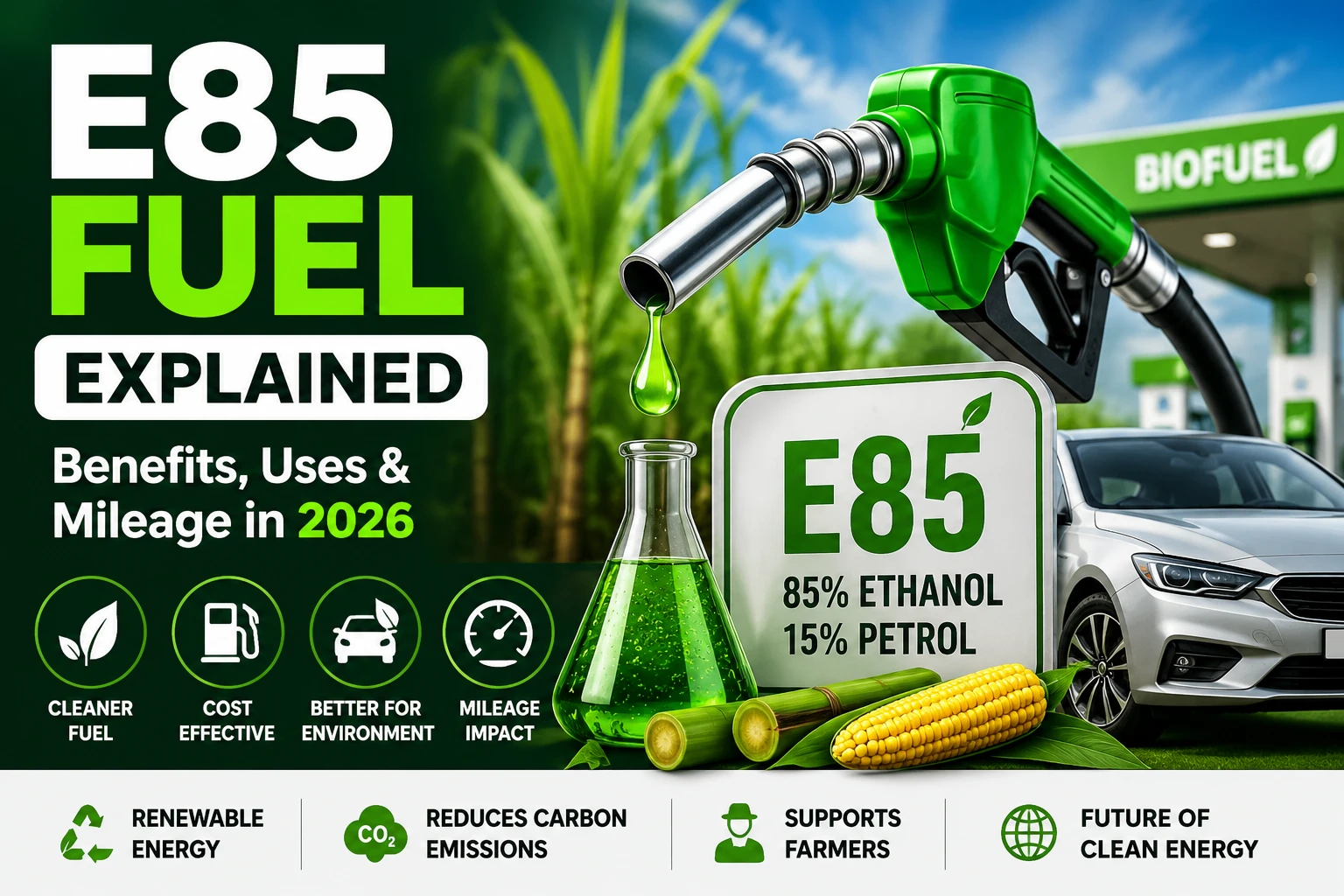
As the global automotive industry moves toward cleaner and more sustainable energy sources, alternative fuels are becoming increasingly important. One of the most talked-about options today is E85, a high-ethanol fuel blend that offers environmental and economic benefits while supporting renewable energy goals.
Unlike conventional gasoline, this ethanol-rich blend is produced from renewable agricultural resources such as corn and sugarcane. Because of its lower carbon footprint and higher octane rating, many governments and automobile manufacturers are exploring its long-term potential.
In this comprehensive guide, you'll learn how this fuel works, its composition, advantages, disadvantages, mileage impact, vehicle compatibility, and future prospects in 2026.
📑 Table of Contents
- What Is E85?
- How Does This Ethanol Blend Work?
- Fuel Composition Explained
- Major Benefits of Ethanol-Based Fuel
- Potential Drawbacks and Limitations
- E85 vs Petrol Comparison
- Mileage and Fuel Economy Impact
- Compatible Vehicles
- Availability in India
- Future Prospects
- Frequently Asked Questions
- Conclusion
1. What Is E85?
E85 is an ethanol-rich fuel blend containing approximately 85% ethanol and 15% gasoline. The name itself comes from the percentage of ethanol present in the mixture. Ethanol is a renewable biofuel that is commonly produced from crops such as sugarcane, corn, wheat, and other plant materials.
This alternative fuel was developed to reduce dependence on fossil fuels while helping lower harmful vehicle emissions. Because ethanol is derived from renewable resources, it is often viewed as a cleaner and more sustainable transportation fuel.
Many countries have adopted ethanol-blending programs to improve energy security and reduce crude oil imports. As environmental concerns continue to grow, interest in renewable transportation fuels is increasing worldwide.
2. How Does This Ethanol Blend Work?
This renewable fuel works similarly to conventional petrol but has different combustion characteristics due to its high ethanol content. Ethanol contains oxygen molecules that help fuel burn more efficiently inside the engine.
Vehicles designed to use high-ethanol blends are typically equipped with advanced fuel management systems. These systems automatically detect fuel composition and adjust ignition timing, air-fuel ratios, and fuel injection settings.
Because of these automatic adjustments, drivers can switch between petrol and ethanol blends without making manual changes to the vehicle.
This flexibility has made ethanol-powered transportation increasingly attractive in regions focused on reducing greenhouse gas emissions.
3. Fuel Composition Explained
The composition of this fuel blend is relatively simple but highly effective:
- Approximately 85% Ethanol
- Approximately 15% Gasoline
Ethanol serves as the primary energy source, while gasoline helps improve engine startup performance and overall drivability.
Depending on seasonal weather conditions and local regulations, the exact percentage of ethanol may vary slightly. However, it generally remains much higher than traditional blended fuels.
| Fuel Type | Ethanol Content |
|---|---|
| Regular Petrol | 0% |
| E10 | 10% |
| E20 | 20% |
| E85 | 85% |
4. Major Benefits of Ethanol-Based Fuel
4.1 Renewable Energy Source
Since ethanol is produced from agricultural crops, it can be replenished continuously, making it a sustainable energy solution.
4.2 Lower Carbon Emissions
Compared to traditional petrol, ethanol-rich fuels can help reduce greenhouse gas emissions and support environmental sustainability goals.
4.3 Higher Octane Rating
One major advantage is its naturally high octane rating, which can improve engine performance and reduce knocking in compatible vehicles.
4.4 Supports Agricultural Industries
The production of biofuels creates additional demand for crops such as sugarcane and corn, helping farmers and rural economies.
4.5 Reduced Dependence on Imported Oil
Countries producing ethanol domestically can reduce their reliance on imported petroleum products and improve energy security.
5. Potential Drawbacks and Limitations
5.1 Lower Energy Density
Ethanol contains less energy per gallon than conventional petrol, which can lead to lower fuel economy in some vehicles.
5.2 Limited Fuel Station Availability
In many regions, high-ethanol fuel stations remain limited, making accessibility a challenge for some drivers.
5.3 Vehicle Compatibility Requirements
Not all vehicles are designed to use ethanol-rich blends. Specially engineered Flex-Fuel Vehicles are generally required.
5.4 Cold Weather Performance
In extremely cold climates, ethanol-based fuels may require specific engine calibrations for optimal starting performance.
6. E85 Fuel vs Petrol: Which Is Better?
When comparing E85 Fuel with conventional petrol, several factors come into play, including performance, fuel economy, environmental impact, and long-term sustainability. E85 Fuel is designed to reduce dependence on fossil fuels while supporting cleaner transportation solutions.
Traditional petrol remains the most commonly used fuel worldwide because of its high energy density and widespread availability. However, E85 Fuel has gained popularity due to its renewable nature and lower carbon emissions.
| Feature | E85 Fuel | Petrol |
|---|---|---|
| Renewable | Yes | No |
| Carbon Emissions | Lower | Higher |
| Octane Rating | Higher | Lower |
| Mileage | Slightly Lower | Higher |
| Availability | Limited | Widely Available |
7. Mileage Impact of E85 Fuel
One of the most frequently asked questions about E85 Fuel is whether it affects mileage. Since ethanol contains less energy per gallon than petrol, vehicles running on E85 Fuel may experience lower fuel economy.
In most cases, drivers can expect approximately 15% to 30% lower mileage when compared to conventional petrol. The actual difference depends on engine design, vehicle weight, road conditions, and driving habits.
Despite the reduction in fuel economy, some users choose E85 Fuel because of its environmental advantages and potential cost savings when fuel prices are favorable.
8. Which Vehicles Can Use E85 Fuel?
Not all vehicles are capable of running on E85 Fuel. Most standard petrol vehicles are not designed to handle such high ethanol concentrations.
To safely use E85 Fuel, drivers typically need a Flex-Fuel Vehicle (FFV). These vehicles are specially engineered with components that resist ethanol-related corrosion and can automatically adjust fuel delivery settings.
Common Flex-Fuel Vehicle Features
- Advanced engine control systems
- Ethanol-resistant fuel components
- Automatic fuel blend detection
- Enhanced fuel injection technology
- Optimized combustion performance
Before switching to E85 Fuel, always consult your vehicle owner's manual or manufacturer recommendations.
9. E85 Fuel in India
India has made significant progress in promoting ethanol-blended fuels over the last few years. The government has introduced various initiatives aimed at reducing fuel imports and increasing renewable energy adoption.
Although E85 Fuel is not yet widely available across the country, ethanol production continues to expand rapidly. India's strong sugarcane industry provides a solid foundation for future growth in ethanol-based transportation fuels.
As infrastructure develops and more compatible vehicles become available, E85 Fuel could play a larger role in India's transportation sector.
10. Future of E85 Fuel
The future of E85 Fuel looks promising as governments and automobile manufacturers continue investing in sustainable mobility solutions. Growing concerns about climate change and energy security are increasing interest in renewable fuels.
Many experts believe E85 Fuel will continue to complement electric vehicles and other alternative transportation technologies. Advances in ethanol production may also improve efficiency and reduce costs in the coming years.
As public awareness grows and fuel infrastructure expands, E85 Fuel could become a more common choice among environmentally conscious drivers worldwide.
Frequently Asked Questions (FAQs)
What is E85 Fuel?
E85 Fuel is a fuel blend containing approximately 85% ethanol and 15% gasoline. It is commonly used in Flex-Fuel Vehicles.
Is E85 Fuel better than petrol?
E85 Fuel offers environmental benefits and higher octane ratings, while petrol generally provides better fuel economy and wider availability.
Can regular cars use E85 Fuel?
Most standard vehicles are not designed for E85 Fuel. Flex-Fuel Vehicles are generally required.
Does E85 Fuel improve performance?
Its higher octane rating can improve performance in compatible engines designed to utilize ethanol-rich fuel blends.
Is E85 Fuel available in India?
Availability remains limited, but ethanol-blending infrastructure continues to expand across the country.
Conclusion
E85 Fuel represents an important step toward cleaner and more sustainable transportation. With its renewable origins, lower emissions, and strong government support, E85 Fuel offers several advantages over conventional petrol.
Although challenges such as lower mileage and limited availability remain, ongoing advancements in biofuel technology are expected to improve adoption rates. For compatible vehicles, E85 Fuel can be a practical and environmentally responsible fuel choice.
As countries continue investing in renewable energy and alternative fuels, E85 Fuel is likely to play an increasingly important role in the future of transportation.
✍️ About Toolxy Editorial Team
Toolxy Editorial Team publishes accurate, well-researched, and reader-friendly content related to automobiles, technology, finance, education, and trending topics. Our mission is to provide trustworthy information that helps readers make informed decisions.
Found this guide useful? Share it with friends, family, and automobile enthusiasts who want to learn more about E85 Fuel and renewable transportation solutions.
This article is for informational purposes only. Fuel specifications, regulations, prices, and vehicle compatibility may vary by country and manufacturer. Always consult official guidelines before using any alternative fuel.
🔗 Recommended Resources
To learn more about renewable fuels, ethanol blending, and sustainable transportation, explore these trusted resources: